Monday, January 01, 2024

My paper in the Royal Studies Journal

I am delighted to announce that my paper entitled “Large wen” or “swelling”?  Exploring Myths and Misconceptions about Nicholas Sander’s Description of Anne Boleyn and Its Link to Witchcraft was published in the Royal Studies Journal in December 2023. 


Here's an abstract:

Despite the recent surge in Anne Boleyn-themed books and articles, scholars still cannot agree on the subject of Anne and witchcraft. There are two polarising schools of thought: one is that Anne had “the physical characteristics of a witch,” based on the hostile account of Nicholas Sander, and the other that she was never “branded a witch in her own lifetime.” This essay argues that neither of these two views is correct and that there is enough compelling evidence to refute them both. It is time to return to the original source material and re-evaluate this part of the narrative of Anne Boleyn’s life. 

And here is an excerpt from the introduction. You can read the entire paper here since it's an open access.

"One of the most enduring descriptions of Anne Boleyn comes from one of her ardent enemies. In 1585, Edward Rishton posthumously published the work of Nicholas Sander, Catholic propagandist in exile, entitled De origine ac progresu schimsatis anglicani.[1] The book was translated in 1877 by David Lewis as The Rise and Growth of the Anglican Schism.[2] Published in Latin in Cologne, Sander’s book quickly became a bestseller. By the seventeenth century, Sander’s De Origine had been translated into French, German, Italian, Portuguese, Polish, and Spanish. The book was not published in English until the nineteenth century, when the religious controversies related to the reign of Henry VIII had long cooled down. Nevertheless, the English people read Sander’s book in Latin with enthusiasm, and it was especially popular with exiled Catholics during the reign of Anne Boleyn’s daughter, Elizabeth I. Sander’s work laid the foundation for modern theories of portraying Anne Boleyn as a witch.

In 1989, Retha M. Warnicke proposed that Anne’s sudden downfall and execution were triggered by her miscarriage of a deformed male foetus in January 1536, which led to suspicions of witchcraft, adultery, and incest.[3] This theory hinges on Nicholas Sander’s description of Anne’s physical appearance and on his assertion that she had miscarried a “shapeless mass of flesh” in 1536.[4] Whereas the theory that Anne had given birth to a deformed foetus and this triggered her downfall has long been debunked by such historians as Eric Ives and Suzannah Lipscomb, the theory that Sander aimed at depicting Anne as a witch by describing her physical appearance is still credited in academia. Eamon Duffy in his 2017 Reformation Divided Catholics, Protestants and the Conversion of England repeats after Warnicke that “for Sander she [Anne Boleyn] was in fact a sort of witch, who enchanted the King, her seductive powers a triumph of artifice over nature.”[5] Yet it will be argued in this essay that Sander was not aiming at depicting Anne as a witch."                                                                                                                      


[1] Nicholas Sander, De origine et progressu schismatis Anglicani (Cologne, 1585), 17.

[2] Nicholas Sander, Rise and Growth of the Anglican Schism, trans. by David Lewis (London: Burns and Oates, 1877).

[3] Retha M. Warnicke, The Rise and Fall of Anne Boleyn (Cambridge: Cambridge University Press, 1989), 241, 297.

[4] Sander, Rise and Growth, 132.

[5] Eamon Duffy, Reformation Divided Catholics, Protestants and the Conversion of England (London: Bloomsbury Publishing, 2017), 217.


Sunday, October 29, 2023

My new book is OUT NOW!

 🥁Drumroll please! 🥁

My new book "The Forgotten Years of Anne Boleyn: The Habsburg & Valois Courts" is out NOW in paperback, hardcover & eBook formats. I would be honoured if you buy the book, and happy if you glean new insights into Anne Boleyn's forgotten years. 👇👇👇


Wednesday, August 09, 2023

The Forgotten Tudor Women on Not Just the Tudors podcast

Hello everyone,

This is just a quick post to let you know that the new episode of Not Just the Tudors podcast with Professor Suzannah Lipscomb is out now and I'm in it!


I was invited to talk about the forgotten Tudor women Anne Seymour, Jane Dudley & Elisabeth Parr.

Please take a listen & enjoy!


Sunday, February 12, 2023

My article in the newest issue of History of Scotland magazine

I wrote an article for the newest issue of History of Scotland magazine , focusing on the relationship between Anne Boleyn & Henry VIII's elder sister Margaret Tudor, Dowager Queen of Scots.

While researching my newest book "Ladies-in-Waiting: Women Who Served Anne Boleyn", I came across a letter Margaret wrote to Anne in 1534 so I decided to explore it further.
The relationship between the two queens is rarely mentioned so I think it's going to be an interesting read for Anne's fans.


Sunday, January 15, 2023

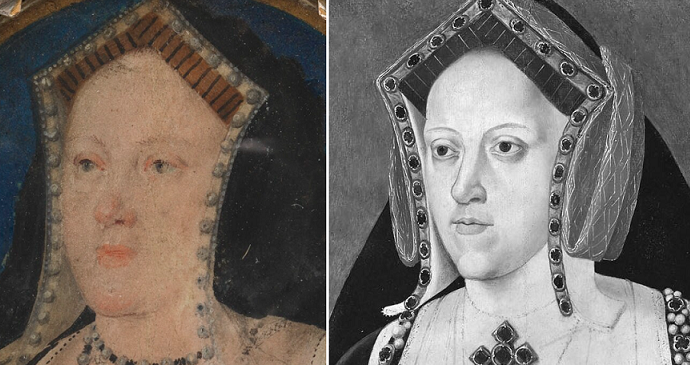
Did Katherine of Aragon suffer from prognathism?

Did Katherine of Aragon suffer from prognathism? 

This is an excerpt from my book "Medical Downfall of the Tudors: Sex, Reproduction & Succession" (pp. 111-113).

"In 1519, Francis I quipped that Henry VIII “has an old deformed wife, while he himself is young and handsome”.[i] It is generally assumed that the French King was referring to Katharine’s corpulent figure; several years later one eyewitness described her as “of low stature” and “rather stout”.[ii] Yet there’s evidence that Francis was referring not only to Katharine’s bulky figure but also to a deformity of her jaw—a deformity that has been overlooked by modern historians until now.

In the vast collections of the Victoria & Albert Museum in London, there is a boxwood draughtsman that bears a portraitof Katharine of Aragon, dating to c. 1535.[iii] She is depicted in profile to the left, with her head covered by a hood of English making, and wears a dress with a low-cut décolletage that emphasises her ample bosom. Around her neck, she wears a chain with a pendant. The feature that draws the viewer’s attention is the half-opened, jutting jaw. 


This is not the only depiction of Katharine with a pronounced jaw. The Kunsthistorisches Museum in Vienna holds a set of twenty-seven boxwood-on-walnut game pieces, dating to c. 1535, depicting various historical personages of the sixteenth century.[iv] Katharine of Aragon is one of them: She is depicted wearing similar headdress, clothes and pendant as in the Victoria & Albert boxwood draughtsman but faces the viewer with her eyes turned to the left. Like in the Victoria & Albert piece, her jaw is half-opened and pronounced. 


The National Portrait Gallery in London preserves a miniature of Katharine, dating to c. 1525-26, wherein her jaw is more pronounced that in other known portraits.[v] Finally, the Museum of Fine Arts in Boston has a portrait of the Queen wherein her jaw is closed but clearly jutting.[vi]


The abovementioned evidence suggests that Katharine of Aragon suffered from mandibular prognathism, much like her Habsburg nephew Charles V (Katharine’s sister Joanna married into the Habsburg dynasty in 1496, espousing Philip the Handsome, Duke of Burgundy). The so called “Habsburg jaw” refers to the inherited trait which was present and clearly evident in the Habsburg family, Maximilian I and Charles V being the most prominent examples in the sixteenth century. This condition manifests itself as a jutting of the jaw. Yet the Habsburgs were not the only ones who suffered from prognathism. The Trastámara dynasty, from which both of Katharine’s parents descended, had several members who suffered from prognathism. Katharine’s half uncle, Henry IV of Castile, was the most prominent example, as evidenced by his skeletal remains. John II of Castile, Katharine’s maternal grandfather, also suffered from prognathism, as did the first Trastámara King of Castile, Henry II. Clearly, prognathism ran in Katharine of Aragon’s family and was a trait she inherited."


Sources:

[i] Calendar of State Papers Relating To English Affairs in the Archives of Venice, Volume 2, 1509-1519, n. 1230.

[ii] Calendar of State Papers Relating To English Affairs in the Archives of Venice, Volume 4, n. 694.

[iii] Catherine of Aragon, gamesiece, Museum number: A.35-1934, http://collections.vam.ac.uk/item/O96204/catherine-of-aragon-gamespiece-kels-hans

[iv] The Kunsthistorisches Museum, KK 3851-77.

[v] Katherine of Aragon, attributed to Lucas Horenbout (or Hornebolte), watercolour on vellum, circa 1525-1526, NPG L244, https://www.npg.org.uk/collections/search/portrait/mw191234/Katherine-of-Aragon

[vi] Catherine of Aragon, 48.1142, https://collections.mfa.org/objects/33353

Wednesday, November 23, 2022

Was Francis I really “banging” Mary Boleyn? Discussing Netflix's "Blood, Sex & Royalty"


If anyone asks me if there's really a need for another book on Mary Boleyn, I'm going to say that it's an emphatic YES. It’s a well-established part of the narrative to depict Mary as a duller and less intelligent of the Boleyn sisters. According to Netflix's new documentary series “Blood, Sex and Royalty”, sex was apparently on her mind a lot.

We see the Boleyn girls at the French court. Anne is reading Christine de Pizan’s "Le Livre de la Cité des Dames" ("The Book of the City of Ladies") while a servant is trying to lace Mary into a corset. Anne and Mary are shown walking down the corridor; Mary is acting seductively towards the two courtiers who pass them by (she blows them a kiss) while Anne treads behind her somewhat timidly.  

We hear Dr Suzannah Lipscomb’s commentary: Mary, Anne's sister, "is much more interested in the immediate pleasures and the immediate satisfactions of things, whereas Anne, she holds out for something more.”

Then we see Anne again, who introduces Francis I, King of France: “King Francis: Ruler of France, patron of the arts and banging my sister".


The two sisters are pitted against each other in an already familiar fashion. Anne: bookish, intelligent, quick-witted. Mary: looking for carnal pleasures, not the type of girl you would call learned ("you can't possibly have read all these", Mary says as she's pointing at the pile of books belonging to Anne despite the fact that in her own letter Mary once mused that she read "old books" too). 


Was Francis I really “banging” Mary Boleyn?


Every single book about the Tudors tells the same tale: Mary Boleyn became Francis I's mistress at some point during her stay at the French court. Francis, however, had only two known mistresses (the official title was maîtresse-en-titre) and a lot of sexual partners. Maîtresse-en-titre was an office and if Mary became the King's mistress, we would have more evidence of it. Did they have sex? Perhaps; if anything happened between them, it was likely a fling. 


The notion that Mary Boleyn was sexually promiscuous during her stay at the French court is based on the French King’s reminisce from 1536, when he boasted that he knew Mary Boleyn “here in France” as “una grandissima ribalda” which means more or less that she was notoriously infamous for her promiscuity. The whole report was recorded by Rodolfo Pio di Carpi, Bishop of Faenza, who stated that:


“Francis said also that they are committing more follies than ever in England, and are saying and printing all the ill they can against the Pope and the Church; that ‘that woman’ pretended to have miscarried of a son, not being really with child, and, to keep up the deceit, would allow no one to attend on her but her sister, whom the French king knew here in France ‘per una grandissima ribalda et infame sopre tutte’ [“a great wanton and notoriously infamous”].” [1]


No other contemporary source records Mary’s allegedly infamous reputation. In the 1580s, Nicholas Sander hinted that Anne Boleyn was Francis I's mistress and known in France as his mule or mare; perhaps he confused the Boleyn sisters or was just trying to be malicious. His book entitled "The Rise and Growth of the Anglican Schism" depicted Anne and her family as lechers and heretics so anything Sander says is mostly based on lies or anti-Boleyn propaganda that circulated during their times. If the Boleyn sisters were indeed as notorious for their promiscuity as Nicholas Sander and Rodolfo Pio di Carpi claimed, the rumours would have been circulating in England as well as in France, and it remains dubious whether Henry VIII would take one sister as his mistress and the other as his wife had they been so notorious.

Also it looks like the Bishop of Faenza was referring to Anne and not Mary when he made a comment about “that woman...whom the King knew here in France”. I doubt that Mary Boleyn was notoriously promiscuous because there’s just not enough evidence to substantiate this claim. 

 Pio's report is wrong on many levels. First, “that woman”, Anne Boleyn, was indeed pregnant and did not pretend to have miscarried a son—she really did miscarry a foetus that had the appearance of a male, at about fifteen weeks’ gestation, as recorded by a contemporary chronicler. [2]  There is also no tangible evidence that Mary Boleyn was back at court after she and her newly wedded husband, William Stafford, were banished for marrying in secret in 1534. Because of these glaring errors, the report is generally regarded with a touch of reserve when it comes to Anne Boleyn. Oddly, it is rarely questioned when it comes to Mary, and the Bishop of Faenza’s words are often quoted to prove that Mary was Francis I’s mistress and sexually promiscuous because it is assumed that the French King “knew” Mary in the carnal sense.


PS. The only historian who challenged the view that Mary Boleyn was promiscuous while in France is Retha M. Warnicke, who pointed out that in 1514 Mary Boleyn was too young to achieve such notoriety and that Francis I may have well referred to the 1532 meeting in Calais and “come to this conclusion about her character at that time, aware that she was Henry’s ex-mistress.”  [3] 


 [1] Letters and Papers, Volume 10, n. 450.

 [2] Charles Wriothesley, A Chronicle of England During the Reigns of the Tudors, Volume 1, p. 33.

[3] Retha M. Warnicke, Wicked Women of Tudor England, p. 30.

Saturday, October 15, 2022

Is the NPG portrait of Anne Boleyn really based on a lost original? Update.

Do you remember my last post about the eerie similarity between Anne Boleyn's NPG portrait and Elizabeth I's Compton Verney portrait?
Apparently, these two portraits were painted by the same artist who used similar face patterns. But there's more!
Dr Owen Emmerson - Historian has kindly provided more details when I posted about this on my Facebook page: The artist also painted the Hever corridor portrait of Katherine of Aragon, and the Weiss Gallery portrait of Mary I.
Now look at the spooky similarity in face patterns in the Weiss portrait of Mary I and the NPG portrait of Anne Boleyn. The proportions are identical. These portraits were painted around the same time in the 1580s so that explains a lot. Anne Boleyn's painting was dated to 1584.
I was informed that there is going to be more about this discovery by art historian Lawrence Hendra, so we have to wait for more developments. So far it's truly fascinating.


Friday, September 30, 2022

Is the NPG portrait of Anne Boleyn really based on a lost original?


I don't believe the portrait of Anne Boleyn, currently on display at the National Portrait Gallery in London, is based on a contemporary likeness of Anne.

Why? Hear me out.
There's a portrait of Queen Elizabeth I in the Compton Verney, Warwickshire, bearing a striking resemblance to the NPG portrait of Anne Boleyn. A natural likeness between a mother and daughter, one may say, but look closer:
There are exactly the same brushstrokes running from the nose towards the lips, brushstrokes under the nose and under lips.


Coincidence? I don't think so. It's been my view for years that the NPG portrait of Anne Boleyn was painted during the reign of Queen Elizabeth I and was based on Elizabeth’s face. It’s not what Anne Boleyn would have looked like. The exact same brush strokes around the lower part of Elizabeth’s and Anne’s faces are not coincidental; Elizabeth’s face was probably used as pattern for Anne’s face.

What do you think?

Sunday, June 19, 2022

The real history behind "Becoming Elizabeth": Episode 1: Katherine Parr & Thomas Seymour.

New eight-part drama "Becoming Elizabeth" tells the story of the daughter of Henry VIII and Anne Boleyn before she became Queen Elizabeth I, as she navigated the reigns of her half-siblings, Edward VI and Mary I. But how accurate is the drama? I will discuss the real history behind "Becoming Elizabeth" in a series of blog posts over the coming weeks.


Early in the drama we see a sex scene between Thomas Seymour and Katherine Parr. While some viewers find it difficult to believe that Katherine was "some sex-starved woman who can barely keep her hands off Thomas Seymour", this is not an inaccurate depiction and I'll tell you why. 

Before she married Henry VIII, Katherine had fallen in love with Edward Seymour’s younger brother Thomas. Handsome, athletic and ambitious, Thomas reciprocated her feelings and proposed marriage within days of Henry VIII’s death. The thirty-five-year-old Dowager Queen was torn between duty and her own desires. After three marriages—her husbands were either mentally incapacitated or past their prime—she still had no offspring, although she yearned to have a child of her own. 

As a royal widow, she was expected to wait at least two years before marrying again, but she was not getting any younger, and Thomas urged her “to change the two years into two months”. Before she agreed, Katherine emphasized that her decision did not proceed from “any sudden motion or passion” because she was in love with Thomas before the King started courting her.  

Katherine could not resist Thomas’s charm, and the couple soon embarked in a love affair. YES, a love affair. Their secret marriage probably took place before 17 May 1547 since, in one of his love letters addressed to Katherine, Thomas referred to himself as her husband: “from him whom ye have bound to honour, love, and such in all lawful thing obey”. Katherine reciprocated, signing herself as “her that is and shall be your humble, true and loving wife during her life”.  The couple understood that their wedding was very hasty and could meet with opposition from the influential members of Edward VI’s circle since, as Dowager Queen, Katherine was expected not only to mourn her royal husband at least two years, but also obtain the Privy Council’s approval for remarriage. 

Such a hasty remarriage caused scandal and even Katherine Parr's friend, the Dowager Duchess of Suffolk, could not restrain herself from making a comment: She named a black stallion in her stable 'Seymour' and a bay mare 'Parr'. 

People believed that Katherine remarried to fulfil her repressed sexual desires. It was a common medieval belief, stemming from ancient Greek philosophers, that marriage could protect women from illnesses that usually afflicted those who abstained from sex. It was also a common belief that a woman’s judgement was clouded by her sexual urges. 

When Katherine Parr married Thomas Seymour within months after Henry VIII's death, she knew what she was doing. She was already in her mid-thirties and childless. She was in love and yearned to have a child of her own. She knew her remarriage would cause scandal and yet she remarried anyway. I call that taking things into her own hands. She was, finally, in a position to make her own decision. 

This blog post is based on my book "The Forgotten Tudor Women: Anne Seymour, Jane Dudley & Elisabeth Parr."

Sunday, March 06, 2022

Did Anne Boleyn really play the role of Perseverance in the Chateau Vert pageant in 1522?


 In March 1522, Anne, that “fresh young demoiselle”, as she was dubbed by one observer, made a debut at court during the Chateau Vert pageant.[1] She was among the eight ladies impersonating qualities that a perfect mistress of chivalric tradition should possess. It is usually assumed that Anne played Perseverance, a role that is historically appropriate for the story of Anne’s rise. Contemporary chronicler Edward Hall listed the roles noblewomen played in the Chateau Vert pageant but did not specify who played who. Hall lists: Beauty, Honour, Perseverance, Kindness, Constancy, Bounty, Mercy and Pity.[2] 


A list of ladies who received costumes they wore as mementoes after the pageant appears to be the source of who played whom:


“These things remain with the French queen, the countess of Devonshire, Mistress Anne Boleyn, Mistress Karre, Mistress Parker, Mistress Browne, Mistress Danet and Mistress [blank].”[3]


Someone has apparently merged these two accounts together, resulting in the assumption that Beauty was played by Mary Tudor (Henry VIII’s sister); Honour played by Gertrude Courtenay, Countess of Devonshire; Perseverance played by Anne Boleyn; Kindness played by Mary Carey (Anne Boleyn’s sister); Constancy played by Jane Parker (soon to become Anne Boleyn’s sister-in-law); Bounty played by Mistress Browne; Mercy played by Mistress Danet; and Pity played by an unknown woman. It would not have been impossible for these women to play these exact roles; Mary Tudor, for instance, was praised for her physical attractiveness, so the role of Beauty seems apt. She was also the former queen consort of France and highest in rank; the role of Beauty would have been assigned to her as she was the other women’s social superior. Ultimately, however, we cannot be sure who played whom. 


The ladies wore satin gowns cut in Italian fashion, close-fitting golden cauls and bejewelled Milan bonnets. Each woman’s role was sewn onto her costume for everyone to see.


[1] William Dunn Macray, The History of Grisild the Second, p. 53.

[2] Edward Hall, Hall's Chronicle, p. 631.

[3] Letters and Papers, Henry VIII, Volume 3, 1519-1523.


Wednesday, January 06, 2021

Myth-buster: Did Katharine of Aragon really die in the arms of Maria de Salinas, Lady Willoughby?


One of the most persistent myths about Katharine of Aragon’s last hours is that she died in the arms of her Spanish lady-in-waiting and friend Maria de Salinas, Lady Willoughby.[i] Maria “who has faithfully served her [Katharine of Aragon], and who has always comforted her in her hours of trial”, had received letters patent of denization and married William Willoughby, Baron Willoughby de Eresby, in 1516.[ii] Katharine of Aragon and Henry VIII had financed Lady Willoughby’s marriage, giving her a dowry worth eleven hundred marks. She was so much favoured by Katharine that it was said that the Queen loved her “more than any other mortal”.[iii] In July 1534, Maria, whose only daughter married Charles Brandon, Duke of Suffolk, was forced to leave Katharine’s service. Distressed, Chapuys recorded this fact, writing that “even a Spanish lady who has remained with her all her life, and has served her at her own expense, is forbidden to see her”.[iv]


“I heard say that my mistress is very sore sick again”, Maria wrote in a letter to Secretary Thomas Cromwell on 30 December 1535. She desired to see Katharine, but she needed a special licence from the King. “I pray you remember me of your goodness”, she urged Cromwell, “for you did promise me to labour the King’s Grace to get me licence to go to her Grace afore God send for her; for, as I am informed, there is no other likelihood but it shall be shortly”.[v] Maria feared that she would be unable to see Katharine for the last time, but Cromwell was unmoved and failed to reply.

Maria decided to defy both Thomas Cromwell and Henry VIII, and on 1 January 1536, she travelled on horseback through snowy weather to the remote Kimbolton Castle, Katharine of Aragon’s residence. She reached her destination at six o’clock in the afternoon and knocked at the castle’s doors. Katharine of Aragon’s servants were dismayed to see Maria, whom they did not expect. Maria claimed she had a fall from her horse while travelling. She was distressed and, in a bid for sympathy, told Katharine’s chamberlain that “she thought never to have seen the Princess Dowager again by reason of such tidings as she had heard of her”. But the chamberlain demanded to see the licence, which Maria did not have. “It was ready to be showed”, she replied, but when she left Kimbolton after seeing Katharine for the last time, the chamberlain wrote on 5 January that “since that time we never saw her” nor “any letters of her licence hither to repair”.[vi] Katharine of Aragon died two days later, on 7 January 1536.


[i] I found that the earliest reference to this myth comes from the 1962 biography Catherine, Duchess of Suffolk: A Portrait by Evelyn Read. It was repeated in subsequent biographies including the 1970 A Crown for Elizabeth by Mary M. Luke, 1977 Women of Action in Tudor England by Pearl Hogrefe and 1996 The Six Wives of Henry VIII by Antonia Fraser.

[ii] Calendar of State Papers, Spain, Volume 2, n. 238.

[iii] Ibid., n. 201.

[iv] Letters and Papers, Foreign and Domestic, Henry VIII, Volume 7, n. 1013.

[v]  M.A. Everett Wood, Letters of Royal and Illustrious Ladies of Great Britain, Volume 2, pp. 208-9.

[vi] Letters and Papers, Foreign and Domestic, Henry VIII, Volume 10, n. 28.